I ordered some transfer paper for my pottery a while back just as background text to draw on top of it. All I could see was cursive text, I had no idea what it said.
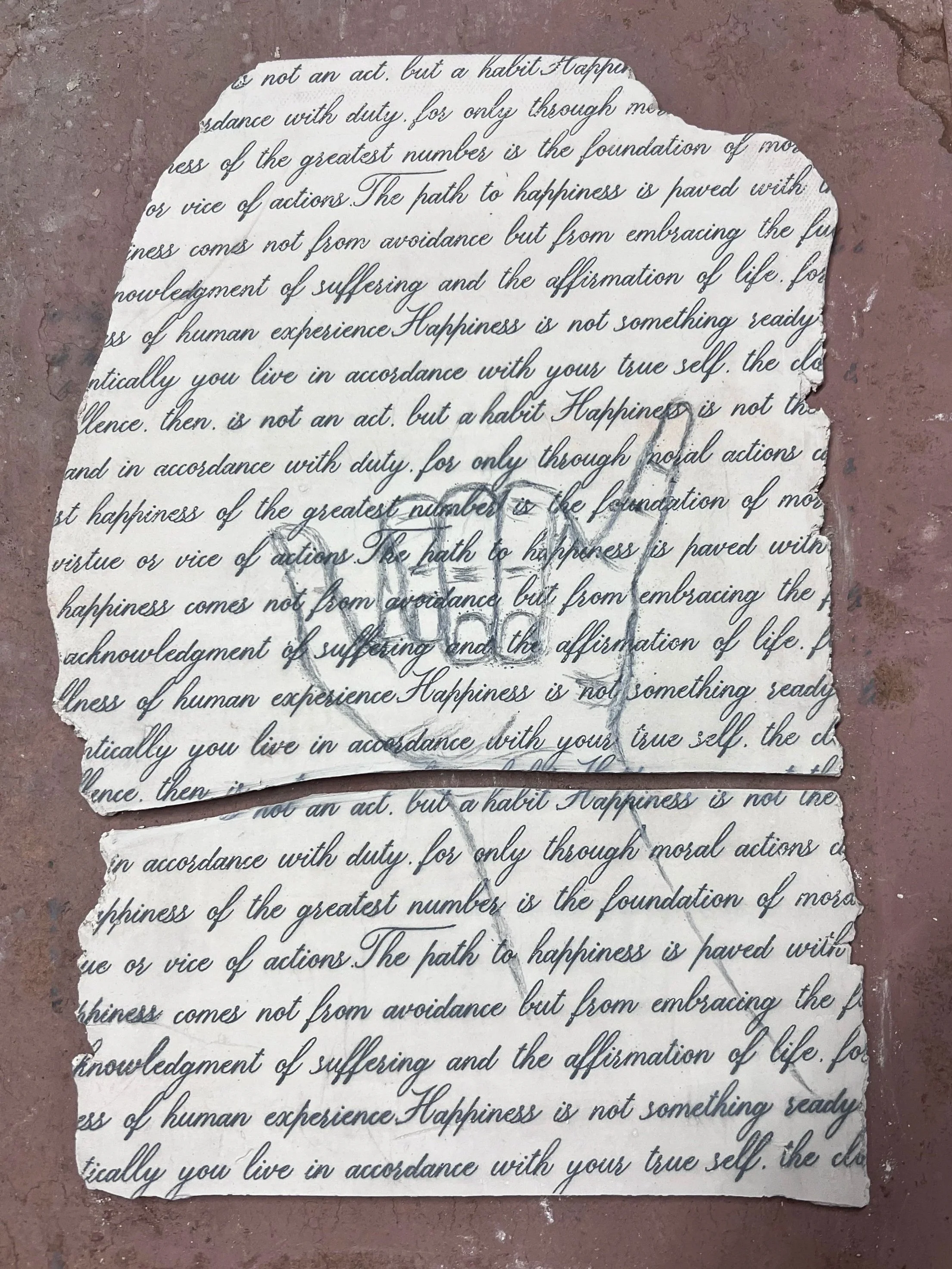
As I began working with it, I finally stopped to read the words.
Happiness. Morality. Suffering. Avoidance. Living authentically. The greater good.
Some of the very things I've been thinking about lately—in relationships, family dynamics, nationally, internationally, my creative work, and trying to make sense of the world around me.
And then, while drawing the final point of a shaka—the Hawaiian hand gesture associated with aloha, goodwill, and connection—the piece broke in two.
On Election Day.
Of course it did.
There I was, creating a symbol of connection, looking down at two separate pieces of what had been one. I couldn't help seeing the divisions around us.
Unity, Participation, and Being Heard
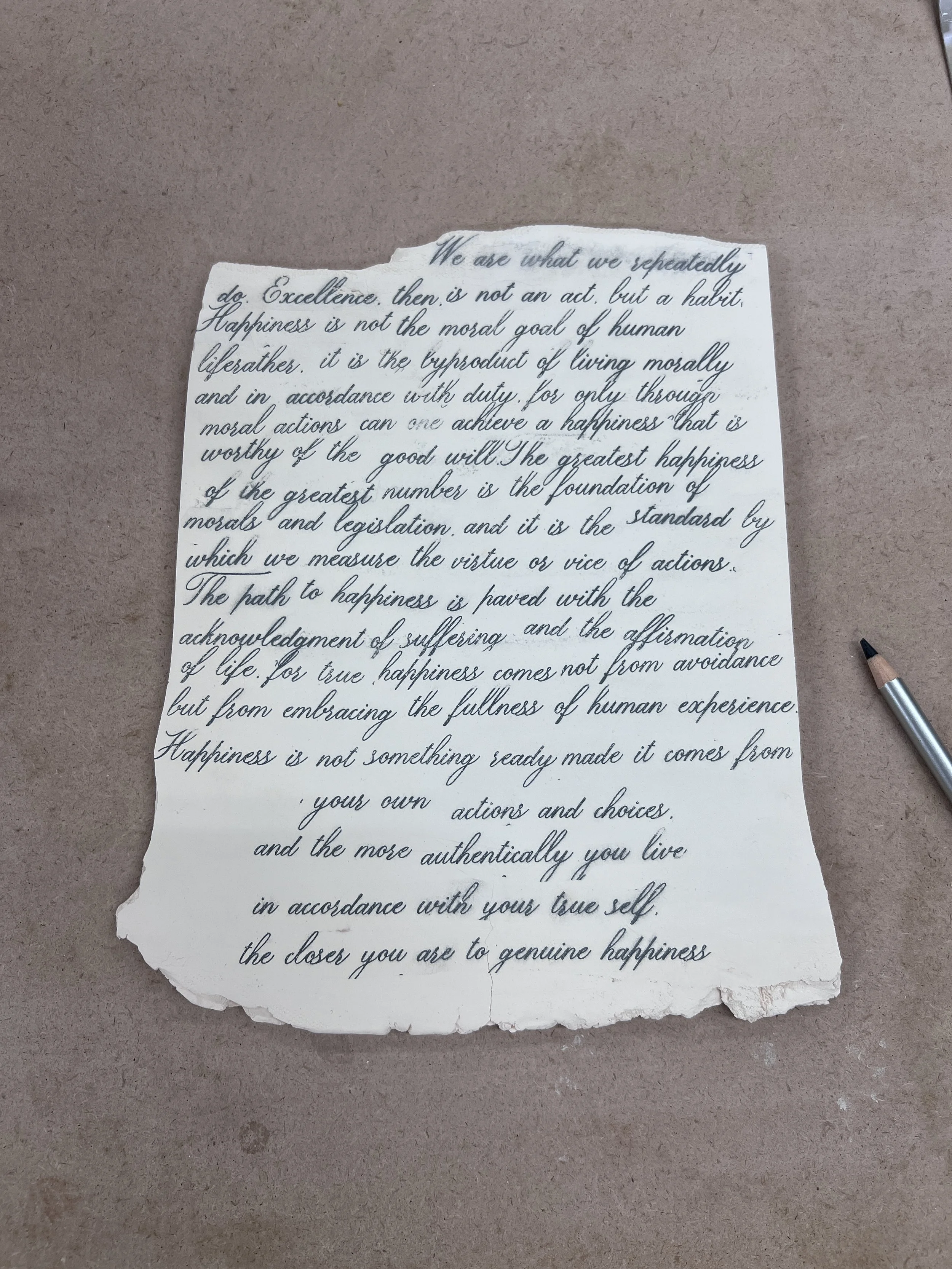
My first thoughts went to three principles I've spent years yearning and learning through Al-Anon Family Groups* that have helped me navigate relationships, boundaries, communication, and my own emotional growth.
Tradition One, paraphrased: The group's common welfare comes first. Unity supports everyone's progress.
(This principle- the same for most 12 step programs, the very first tradition, really makes it clear on the idea of what unity is. "The greatest happiness of the greatest number..." from the pottery text...Taking the self out of it while putting the group as a whole first and foremost. Personal beliefs out of the situation, while still belonging as part of the whole.)
Concept Four, paraphrased: Harmony depends on everyone's participation.
Concept Five, paraphrased: Minority viewpoints deserve the right to be heard and considered.
Unity. Participation. Minority voices being heard.
These principles have helped guide several fellowships made up of millions of people with different backgrounds, personalities, experiences, and beliefs for generations.
Not because everyone agrees. Not because everyone thinks alike.
And certainly not because everyone gets their way.
But because the structure recognizes the importance of participation and the value of voices that might otherwise be overlooked.
Unity doesn't require conformity. Harmony doesn't require silence. And the majority doesn't automatically have all the answers.
I find myself wondering why principles that have helped so many fellowships continue for decades can be so difficult to practice in our own families, organizations, communities, and nation.
How often is unity confused with conformity?
How often is disagreement treated as disloyalty?
How often does the desire for harmony become an expectation that someone remain silent?
Who decides which voices are worth hearing?
If the price of belonging is silence, is that really unity?
And that brought me back to the shaka.
A Breath of Fresh Air
The shaka represents more to me than a familiar Hawaiian gesture. It reminds me of a time in my life when I was exposed to people with different backgrounds, cultures, beliefs, faiths, and ways of seeing the world.
And what a breath of fresh air that was.
There was something incredibly freeing about stepping outside the bubble of what I had always known—or thought I knew. Different customs. Different philosophies. Different ways of communicating, connecting, and understanding life. Even healing.
I didn't have to agree with everything I encountered to appreciate it. I didn't have to adopt someone else's beliefs to learn from them. And discovering another perspective didn't mean I had to abandon my own.
Even the way my roommates and hanai family handled difficult conversations was refreshing. If something bothered them—often something I was doing!—they spoke up honestly and respectfully. There was room to be ourselves, express differences, and still feel accepted. I appreciated that maturity and learned so much from it. It was amazing.
In that community, everyone was accepted and belonged, including me. It was... different from where I came from. (This was an era before program, where acceptance and belonging also reign true).
I began to appreciate how much we don't know when we remain surrounded by people who think, believe, and live much like we do.
It's easy to mistake what's familiar for what's normal. And what's normal to us for what's right.
But there's an enormous world beyond our own experiences. And sometimes getting outside our bubbles is exactly what we need to see it.
The shaka reminds me of that openness. Of connection without requiring sameness. Of the possibility of belonging among people who see the world differently.
And it makes me think about what happens when that openness is missing.
Black, White, and Everything We Miss in Between
One of the most challenging and destructive things I've encountered in relationships and family dynamics is black-and-white thinking. It certainly has its place in the world, but when it leaves no room for nuance or different perspectives, it can become incredibly damaging.
And I see that same pattern playing out in politics. Different circles, different circumstances, but the same underlying ways of thinking. All connected, whether we recognize it or not.
What happens in one part of a system can affect the whole.
Right or wrong.
Good or bad.
For me or against me.
My way or your way.
No room for nuance. No room for context. No room for the possibility that two seemingly opposing experiences might both contain truth.
I've learned a great deal about this through decades of navigating neurodiverse family dynamics, where differences in communication, interpretation, and cognitive flexibility can create misunderstandings. But black-and-white thinking isn't exclusive to any neurotype. We all do it. Especially when we're emotionally invested, frightened, anxious and triggered by past trauma, or just simply convinced we're right. Awareness is always key.
The trouble begins when our certainty leaves no room for someone else's experience.
When a different interpretation is immediately dismissed.
When explaining our perspective is perceived as arguing.
When questioning something is interpreted as disrespect.
When expressing hurt is met with a list of reasons why we shouldn't feel that way.
When someone else's reality is invalidated or dismissed because it doesn't match our own.
And when that happens repeatedly, something changes.
People stop explaining.
They stop questioning.
They stop sharing.
They learn that "keeping the peace" is easier than trying to be heard.
But is that really peace? To abandon ourselves over and over? The turmoil that lands inside of us instead?
That hurtful idea that we are not known, could be considered ego as well.
Being heard doesn't mean being agreed with. Being validated doesn't mean being told we're right. It means our experience is acknowledged as worthy of consideration.
Two people can experience the same event differently. One person's experience doesn't erase the other's.
And yet, how often do we behave as though it does?
So many times in the past, my dad used to get frustrated and shout, "WE'RE SAYING THE SAME THING!!!"
Were we? Sometimes we really are. Sometimes we're using different words, approaching something from different directions, or struggling to communicate through our own filters.
Other times we're not saying the same thing at all. And that's okay, too.
The goal shouldn't always be to convince someone to see things our way.
Sometimes the greater achievement is learning to understand why they see things differently. How you really get to know someone. A step toward intimacy instead of being silent strangers.
That willingness to understand is something we have to keep learning, no matter how old we get.
Growing Pains
Growth isn't always welcomed.
When we begin questioning old beliefs, seeing the gray areas, recognizing unhealthy patterns, setting boundaries, or expressing ourselves differently, we're not just challenging our own ways of thinking.
Sometimes we're challenging the emotional maturity of the people around us.
And they will challenge ours.
With a new wave of growth happening, many people who were trained to be silent are now standing up.
And those who were accustomed to their silence are being challenged to grow, too.
Growth can be uncomfortable for everyone involved.
Someone who has always been silent begins expressing opinions. Or maybe they just find the spaces where that is welcomed.
Someone who has always accepted being dismissed is asking to be heard. They know they deserve that.
Someone who has always avoided conflict begins setting boundaries.
Someone who has always seen things one way begins considering another.
These changes can disrupt the familiar dynamics of a relationship or family.
Not because anyone intends to create conflict, but because familiar expectations are being challenged.
Not because someone is being difficult, but because the dynamics of the relationship are shifting.
Not because anyone is necessarily doing anything wrong, but because what once felt familiar no longer works for everyone.
And that requires adjustment.
Emotional maturity isn't simply the ability to remain calm or avoid disagreement.
Avoidance is the harmful part.
It's the ability to tolerate discomfort, recognize that our own perceptions may be incomplete, and make room for another person's experience without feeling that our own is threatened.
It's being able to say, "I hadn't thought of it that way."
Or, "Help me understand."
Or even, "I was wrong."
And sometimes it's being able to hear something we don't like without immediately dismissing the person saying it.
We expect children to learn these skills. How?
How often do we continue practicing them as adults?
How often do we teach children to use their voices, only to silence them when they challenge us?
And how can we expect people to become independent thinkers if questioning, disagreeing, or offering a different perspective comes at the expense of belonging?
These are skills we need in families, friendships, workplaces, communities—and yes, even at a national level.
Our political divisions didn't create every one of these problems. But they certainly give us a very public place to see how difficult it can be to listen, disagree respectfully, consider nuance, and work toward a common good. This public example does bring up that part of me that again and again screams that emotional intelligence, coping skills, and emotional regulation should be taught in schools.
On Election Day, looking at my broken pottery, I couldn't help thinking about our two-party system.
Two sides of what is supposed to be one country.
Different priorities, experiences, beliefs, and visions of what is best.
Some differences are profound and cannot simply be resolved by meeting in the middle. But I wonder how many possibilities we overlook when we approach every issue as a choice between only two sides.
Like black and white thinking.
Only seeing two choices, when there is a plethora of other options and actions available.
What might we discover if we spent more time being curious and less time defending our positions?
What if our ability to function together depended not on eliminating differences, but on developing the maturity to navigate them?
Finding My Own Voice
Of course, there's another layer to all of this. My own.
I've spent a good portion of my life worrying about how other people will react to what I say, and have spent many moons in recovery programs for the effects of "the isms" passed down throughout the generations.
Will they misunderstand me?
Will they disagree?
Will they be offended? (Later learning that is their choice to be offended instead of reaching for clarity or knowing that different perspectives can exist in a loving way).
Will they think less of me?
And perhaps the most uncomfortable question:
Who am I to think I have something worth saying in the first place?
(That one hits home and brings up a lot of emotion, to be fully honest and vulnerable. And it is why it is so important for me to talk about these programs that are available.)
Writing and making art have brought those questions right to the surface.
It's one thing to have ideas swirling around in my own head. It's another thing entirely to put them out into the world, where the trolls are waiting. Where people can interpret them, question them, disagree with them, or dismiss them.
I've worked hard to unlearn the belief that keeping everyone else comfortable is my responsibility.
People-pleasing can look an awful lot like peacemaking. But they're not necessarily the same thing.
Sometimes keeping the peace means avoiding the very conversations that might help us understand one another and get closer. To stop the same cycles and create trust. The little girl in me is still baffled by the lack of understanding of this, still painfully screaming this on the inside.
Should the loudest voice make the decisions?
When the person who sees things differently decides it's easier not to participate at all...
I wonder how many valuable perspectives we've lost because someone was afraid to speak.
Including my own.
There's a contradiction in believing that minority voices deserve to be heard while struggling to give myself permission to use mine.
If participation is the key to harmony, that includes me.
If different perspectives have value, mine does too.
And if unity doesn't require agreement, why am I so afraid of someone disagreeing with me?
But perhaps disagreement isn't what I'm most afraid of. After years of shifting different ways of thinking and communicating, especially when navigating inside relationships with opposite neurotypes, or unresolved trauma, I'm more afraid of being judged for what someone assumes I mean, rather than what I've actually said. Of having thoughts, intentions, or beliefs assigned to me that were never mine in the first place. And then having to defend myself against something I never even said, nor would I even agree with! People committed to misunderstanding me.
Part of learning to use my voice is accepting that I cannot control how everyone receives it. There are two parts to communication and I am not responsible for that latter part.
I can be thoughtful. I can be respectful. I can listen. I can acknowledge when I'm wrong and change my mind when I learn something new.
But I cannot guarantee that no one will take offense.
And maybe that's not the standard I should be trying to meet.
No. It isn't.
Two Sides of the Same Piece
I keep returning to those two pieces of pottery.
They broke apart, but they're still pieces of the same original work.
The writing continues across both surfaces. The ideas haven't changed simply because the material holding them together has fractured.
Repairing it wouldn't erase the break. Leaving it separated wouldn't erase the fact that it was once whole.
And perhaps that's what I'm taking away from all of this.
Unity doesn't mean sameness.
Harmony doesn't mean silence.
And personal growth doesn't mean we've arrived at some final, enlightened understanding.
It means remaining willing to learn.
To question.
To listen.
To recognize that someone else's experience may reveal something we couldn't see from where we were standing.
To challenge our own black-and-white thinking, even when it's uncomfortable.
To make room for different cultures, beliefs, faiths, experiences, and ways of understanding the world.
And to recognize that our voices matter, even when they aren't the loudest or most popular in the room.
The shaka reminds me of a time when stepping outside what I knew opened up an entirely different way of seeing the world.
The broken piece reminds me how easily we can become divided.
And the words I unknowingly chose for my artwork remind me that sometimes meaning is right in front of us, waiting for us to notice.
Maybe the goal isn't to get everyone on the same side.
Maybe it's to become mature enough to recognize that we can be different, disagree, continue growing, and still find ways to belong.
Because unity isn't everyone having the same voice. It's making room for all of them.
——————————————————————————————————————————————————————————————————————
The descriptions of Tradition One and Concepts Four and Five are my personal paraphrases of principles from Al-Anon Family Groups. The reflections in this essay are my own and do not represent the views of Al-Anon Family Groups.
Original ceramic artwork and hand illustrations by myself, Lisa Shaw McKenzie. © 2026. Cheshire Moon Smile. The works are unfired and unglazed, in progress. Decorative underglaze transfer paper commercially purchased; original text compilation source unidentified.